
Guodong Wang’s Research Group Collaborates with the Biodiversity Big Data Center to Build the Dog10K Canine Multi-Omics Database
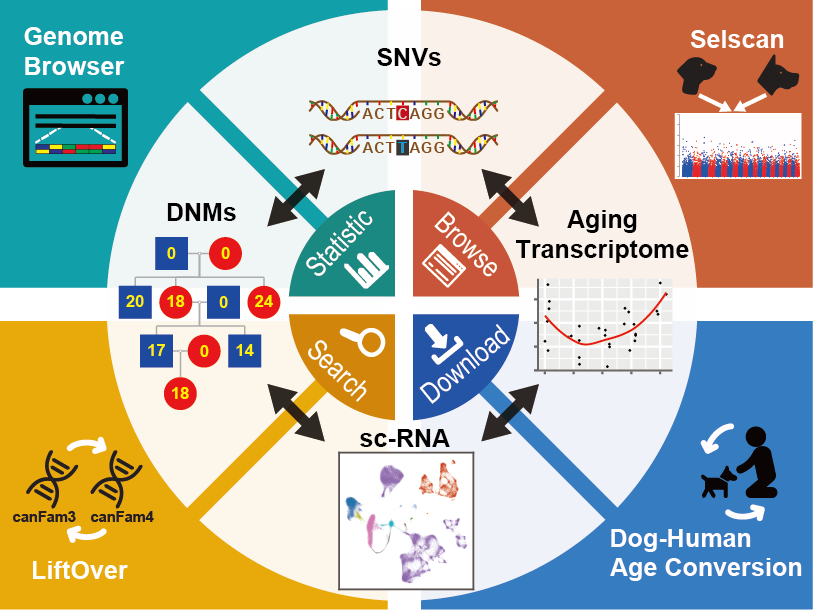
The diversity of dog breeds' phenotypes and the genetic risks associated with dog and human-related diseases make dogs ideal subjects for studying the genetic basis of complex traits and as models for human biomedical research. Dog10K is an ongoing international collaborative project aimed at uncovering the genetic basis of canine phenotypic diversity, diseases, behavior, and domestication history. To better showcase and utilize these vast datasets, Guodong Wang’s research group has collaborated with the Biodiversity Big Data Center to establish the Dog10K database (https://dog10k.kiz.ac.cn/), a comprehensive canine multi-omics database.
The database integrates single nucleotide variations (SNVs) from the genomes of 1,987 dogs, novel mutations (DNMs) from 43 dog breeds, 105,057 single-nucleus RNA-seq (snRNA-seq) data from hippocampal samples, 74,067 single-cell RNA-seq (scRNA-seq) data from white blood cells, and 30 aging transcriptome samples from dogs of various ages obtained from previously published studies. The database offers clear visualization, statistical analysis, browsing, search, and download functions for all data. Additionally, it integrates three analysis tools—Selscan, LiftOver, and AgeConversion—to help researchers customize their exploration of these comprehensive omics data. The Dog10K database will serve as a foundational platform for analyzing, displaying, and utilizing canine multi-omics data, facilitating research on complex traits and genetic diseases, and promoting academic collaboration and the sharing of research outcomes.
On October 21, 2024, the results of this study were published in the renowned journal *Nucleic Acids Research* in a special database issue under the title "Dog10K: An integrated Dog10K database summarizing canine multi-omics." Assistant engineer Tong Zhou from Guodong Wang’s research group and engineer Shaoyan Pu from the Biodiversity Big Data Center are co-first authors. Researcher Guodong Wang and Senior Engineer Yanan Wang are co-corresponding authors. Many members from Guodong Wang’s research group and the Biodiversity Big Data Center participated in this work, with significant guidance and assistance in manuscript writing from Professor Elaine Ostrander. The project was funded by the major "Brain Science and Brain-like Research" project under the 2030 Scientific Innovation program, the National Natural Science Foundation, and the Spring City Program.
Article link: https://doi.org/10.1093/nar/gkae928