
Researcher Guodong Wang Leads the Construction of the Domestic Dog Hippocampus Single-Cell Atlas and Reveals the Relationship Between Cell Types and Domestication
The hippocampus is a crucial part of the brain's limbic system, involved in processes such as episodic memory and spatial cognition. During domestication, the hippocampus also plays an important role, such as contributing to changes in fear memory in domesticated chickens, reduced fear responses in domestic rabbits, and enhanced cognitive functions in pigeons. Whole-genome studies have found that genes related to hippocampal synaptic function have been strongly selected during the domestication of domestic dogs.
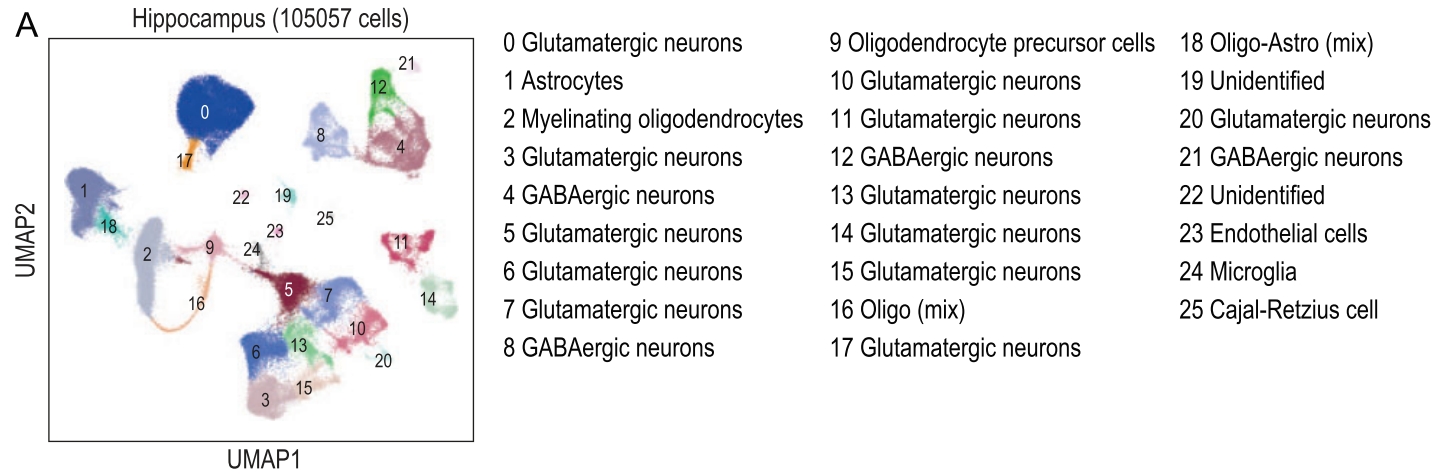
The team of researcher Guodong Wang, in collaboration with researcher Bingyu Mao's team and researcher Shihua Zhang's team from the Institute of Mathematics and Systems Science, Chinese Academy of Sciences, used SPLiT-seq single-cell nuclear transcriptome sequencing technology to map the first single-cell atlas of the domestic dog hippocampus. This atlas defines eight cell types in the domestic dog hippocampus and speculates on their spatial distribution. Joint analysis with previously published human hippocampus data (Zhong et al. 2020) reveals that cell types are highly conserved between humans and domestic dogs. Pseudotime analysis indicates the differentiation process of oligodendrocyte precursor cells in the dog hippocampus, which also exists in human and mouse hippocampi (Zhong et al. 2020, Rosenberg et al. 2018). Results from hypergeometric distribution tests and information entropy analysis show that genes selected during dog domestication (Putative positively selected genes, PSGs) are significantly enriched in the hippocampal differentially expressed genes (DEGs), particularly in glutamatergic neurons. Gene regulatory network results suggest that glutamatergic neurons may influence behavioral changes in the adaptive evolution of domestic dogs by altering synaptic transmission.
This study is the first to explore the domestication mechanism at the cellular level. The work was published in *National Science Review* under the title "A single-nucleus transcriptomic atlas of the dog hippocampus reveals the potential relationship between specific cell types and domestication." PhD students Qi-Jun Zhou and Xingyan Liu from the University of Chinese Academy of Sciences, and PhD student Long-Long Zhang from the Institute of Zoology, Chinese Academy of Sciences, are co-first authors of the paper. Researchers Guodong Wang, Bingyu Mao, and Shihua Zhang are co-corresponding authors. The study was supported by the National Key R&D Program, the Chinese Academy of Sciences Frontier Science Research Program (0 to 1 Original Innovation Project), the National Natural Science Foundation of China, and other funding sources. The single-cell library construction was assisted by the Biodiversity Genomics Center at the Institute of Zoology, Chinese Academy of Sciences.
Article link: https://doi.org/10.1093/nsr/nwac147