
Research Team of Guodong Wang and Yonghan He Achieves New Progress in Anti-Aging Research on Domestic Dogs
Aging is a physiological phenomenon that has long attracted attention. The mechanisms behind age-related functional decline are not yet fully understood. Establishing good animal models is crucial for treating age-related diseases and extending human healthspan. Dogs, as one of the earliest domesticated animals, have coexisted with humans for a long time and share similar living environments and dietary structures. This makes them promising for overcoming many limitations in aging animal models. However, this model is not yet perfect and requires further exploration.
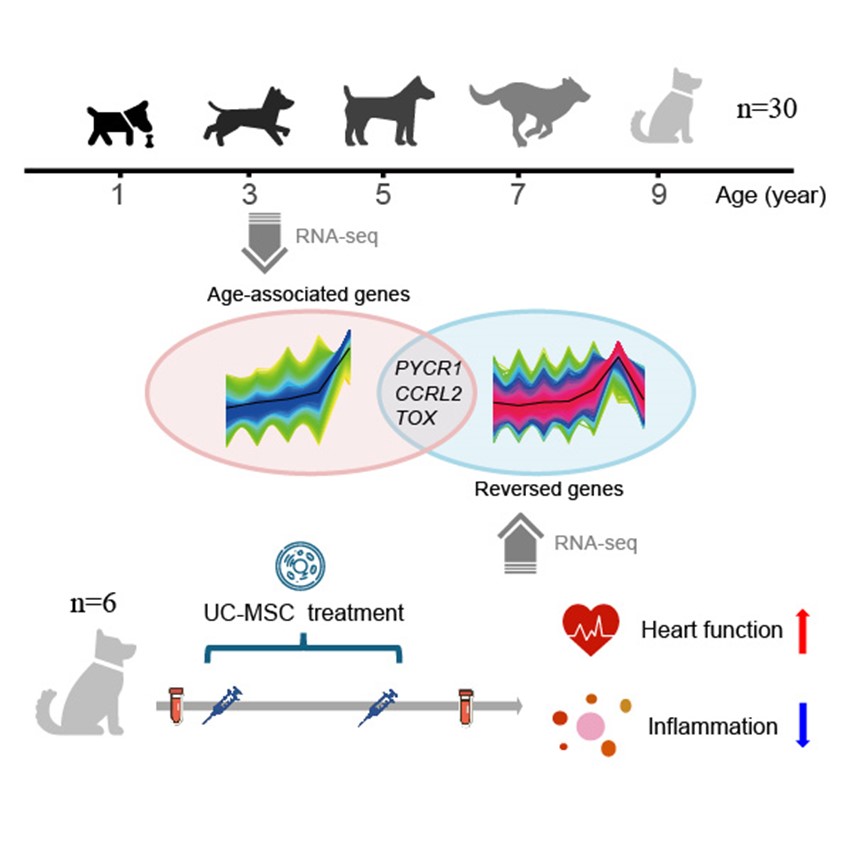
The collaborative research team first collected blood samples from domestic dogs ranging from young to old. Through whole-blood transcriptome sequencing, they constructed an aging baseline for the blood transcriptome and identified 61 age-related genes, most of which were associated with metabolism and immunity. These genes may serve as major markers of canine aging. To find potential intervention targets, the research team applied anti-aging treatments—mesenchymal stem cells, rapamycin, and nicotinamide mononucleotide—to elderly dogs. The results showed that these interventions significantly reduced age-related inflammatory factors (IL-6 and TNF-α). Mesenchymal stem cells were found to effectively improve heart function in elderly dogs. Transcriptomic analysis revealed that PYCR1, CCRL2, and TOX were significantly regulated by mesenchymal stem cells. Both CCRL2 and TOX are closely related to immune aging. These findings unveil major biomarkers of domestic dog aging, and the dog aging model can effectively reflect anti-aging measures, showing great potential in anti-inflammatory research.
On March 2, 2024, the research results were published in the internationally renowned journal *Aging Cell* under the title "Transcriptomic and intervention evidence reveals domestic dogs as a promising model for anti-inflammatory investigation." PhD student Min Zeng, Assistant Engineer Tong Zhou, and Master's graduate Zhiyu Li from Yunnan University were co-first authors. Researcher Guodong Wang and Researcher Yonghan He from the Institute of Zoology, Chinese Academy of Sciences, were co-corresponding authors. Other contributors include Shurun Zhang, Guimei Li, Qingguo Huang, and Lu Wang from the Institute of Zoology, the Kunming Police Dog Base, and Yunnan University. Professor Qingpeng Kong provided significant guidance and assistance for the project. This work was supported by the National Key R&D Program, the Science and Technology Innovation-2030, the National Natural Science Foundation, the Yunnan Provincial Basic Research Program, and the Spring City Plan.
Article link: https://doi.org/10.1111/acel.14127